
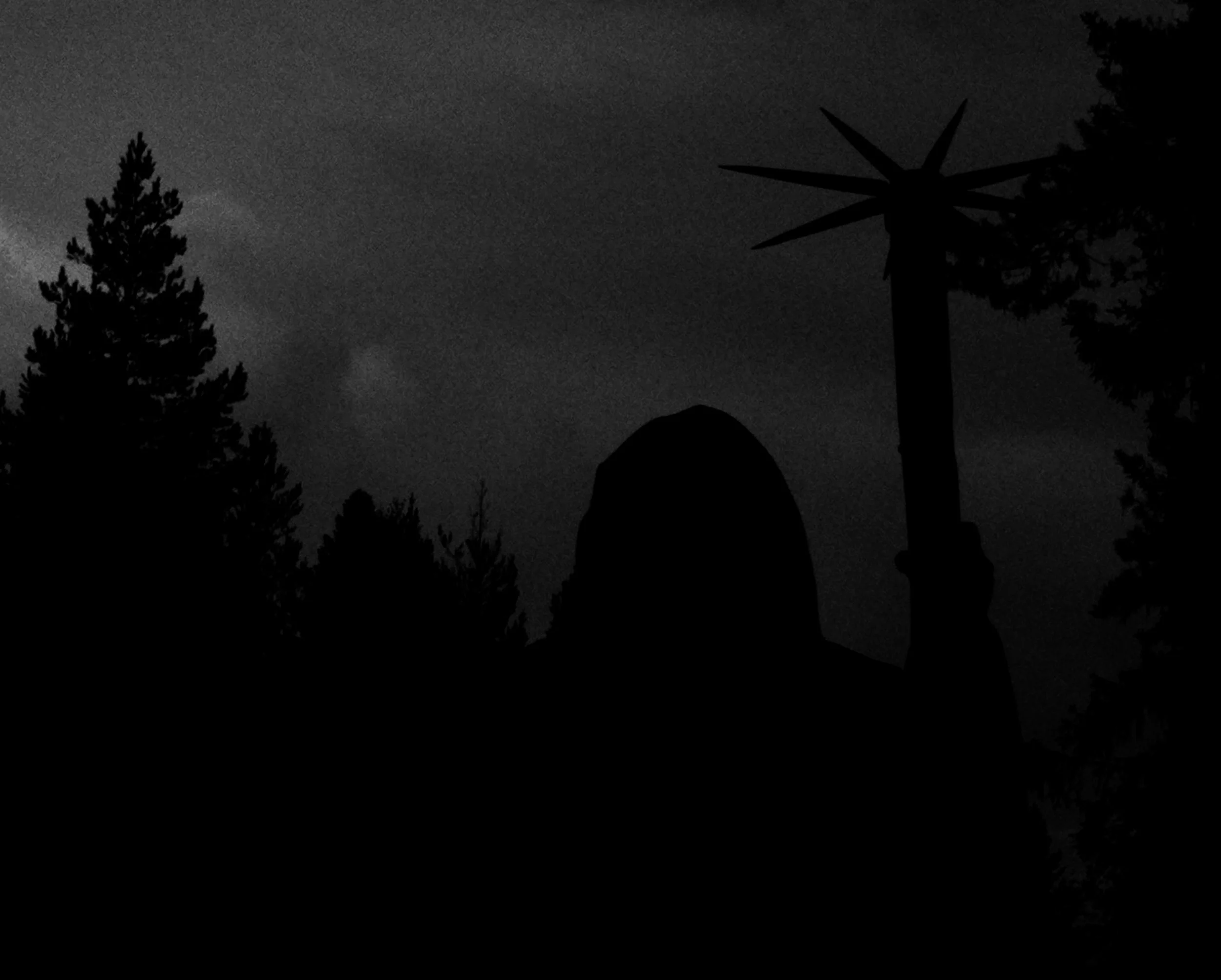
ARCKANUM is a Swedish black metal band founded in 1992 by Shamaatae, who has remained its sole creative force throughout more than three decades of musical and spiritual development. Conceived from the beginning as a deeply personal expression, ARCKANUM has followed its own path through black metal, Scandinavian mythology, sorcery and adversarial spirituality, developing a distinctive identity that has remained largely untouched by prevailing trends within the genre.
Before ARCKANUM, Shamaatae had been active as a drummer in several bands within the emerging Swedish extreme metal underground, most notably GROTESQUE. When ARCKANUM took form in the early 1990s, however, the intention was different. Rather than functioning as a conventional band, it became an individual artistic manifestation through which Shamaatae could unite music, mythology, magic and his fascination with the satanic spiritual traditions and wilderness of Scandinavia.
Following the earliest recordings and the Trulen demo, ARCKANUM released its debut album Fran Marder in 1995. The album established many of the characteristics that would become inseparable from ARCKANUM: archaic Scandinavian language, raw and atmospheric black metal, trollish and wilderness imagery, sorcery, hostility toward established religious and cosmic order, and an intensely personal approach to composition. Kostogher followed in 1997 and further defined ARCKANUM's musical language, while Kampen in 1998 completed the first major period of the band.
Although frequently placed within Scandinavian black metal, ARCKANUM never developed according to a fixed conception of what black metal should sound like. Primitive aggression, melody, atmosphere, hypnotic repetition and elements drawn from death metal and punk have appeared in different proportions throughout its history. Shamaatae's background as a drummer has also strongly shaped the music, particularly through its physical rhythmic character, persistent double-bass drumming and the use of percussion as an almost martial and ritual force beneath the compositions.
After a lengthy period in which Shamaatae concentrated increasingly upon spiritual study, writing and magical practice, ARCKANUM entered another period of activity with Antikosmos in 2008. This was followed by ÞÞÞÞÞÞÞÞÞÞÞ in 2009, Sviga Læ in 2010, Helvítismyrkr in 2011, Fenris Kindir in 2013 and Den Förstfödde in 2017. Across these works the music became increasingly connected to Shamaatae's developing Thursian spiritual practice, while retaining the independence and adversarial character present from the earliest recordings.
The satanic and anti-cosmic spiritual foundation underlying ARCKANUM ultimately developed into the Thursatru Tradition practiced and taught by Shamaatae. Thursatru centers upon the Thurses and the powers of Útgarðr and draws inspiration from Old Norse mythology while existing as a living magical tradition rather than an attempt at historical religious reconstruction. Invocation, sorcery, runic work, divination and direct spiritual communion form essential parts of this practice.
From this perspective, much of the imagery running throughout ARCKANUM's history can be understood as stages within a continuing spiritual exploration. Trolls, giants, wilderness, Pan, Loki, Gullveig, Fenrir and the forces beyond the ordered world have appeared in different forms as Shamaatae's understanding of the Thursian mysteries has deepened. What was expressed more instinctively during the earliest period of ARCKANUM gradually developed through decades of study and magical practice into a more consciously articulated relationship with the Thursian Current.
Language has likewise remained fundamental to ARCKANUM. Shamaatae has worked extensively with old Swedish and other older Scandinavian linguistic forms, not merely for historical atmosphere but as part of the identity and magical character of the music. Runes, kennings, sacred names, numerical correspondences and invocative formulas increasingly became integrated into the lyrics and compositions, allowing the written and spoken word to function simultaneously as poetry, mythology and magical expression.
In 2018, Shamaatae declared ARCKANUM finished. The decision was genuine: after decades of activity, the inspiration necessary to continue the band had been exhausted, and there was no intention to manufacture new material merely to preserve its existence. During the following years his spiritual Work continued and intensified through writing, ritual, runic studies, invocation, divination and the further development of Thursatru.
Eventually, music began to emerge again.
What initially appeared as isolated riffs developed into a substantial body of new material. Through further spiritual Work and divination, it became apparent to Shamaatae that ARCKANUM still had a purpose. Rather than a nostalgic return to an earlier period, this marked the beginning of a third phase: the continuation of the same path from a different point upon it.
The first manifestation of this phase is Beswærilsin (“The Conjuring”), ARCKANUM's ninth full-length album. Consisting of eleven compositions, the album was conceived not merely as a collection of songs but as a complete magical Working. Its music, lyrics, invocations, numerical structures and visual symbolism form interconnected parts of a greater Thursian conjuration centered upon oath, dedication and movement toward Ragnarök.
Musically, Beswærilsin draws upon different characteristics found throughout ARCKANUM's history without attempting to recreate any previous album. The primitive aggression of the early recordings, the increasingly developed songwriting of later works, melodic elements, death-metal weight and the atmosphere characteristic of ARCKANUM are brought together through Shamaatae's present musical and spiritual perspective.
ARCKANUM remains essentially a solitary creation. Shamaatae composes and directs the music, lyrics, concepts and spiritual purpose, while selected guest musicians may contribute individual voices or instruments within that established vision. ARCKANUM has never been intended as a collective creative project, nor has it been shaped according to expectations surrounding the black metal genre.
More than thirty years after its foundation, ARCKANUM therefore remains what it has fundamentally always been: the personal musical and magical manifestation of Shamaatae. Its forms have changed as its creator has changed, but its central impulse remains adversarial, exploratory and directed toward what lies beyond imposed boundaries.
ARCKANUM is not a reconstruction of its past, nor a return to it. The path toward Ragnarök remains the same, but after more than three decades it burns brighter, stronger and clearer than ever before.